Decision guide
Choose the short-term-rental software layer
| Bottleneck | Best starting category | Acceptance test |
|---|---|---|
| Repeated guest questions | Guide and connected communication | Correct one fact and verify every view |
| Conflicting channel calendars | Channel manager or PMS | Run booking, change and cancellation |
| Owner and payment operations | Comprehensive PMS | Reconcile a representative stay |
| Direct presence | Direct website and confirmation workflow | Verify total, status and calendar |
| Large team | Roles, audit trail and escalation | A replacement handles an exception |
Start with the short-term-rental journey, not a software catalogue
A reservation moves through discovery, confirmation, preparation, arrival, stay, departure and turnover. Each transition can fail when dates change, a task is not acknowledged or an old instruction is sent. Mapping those transitions exposes the controls software must provide.
Feature lists encourage teams to buy breadth before defining responsibility. Instead, record repeated work and recent incidents, then identify the source, owner, trigger, stop condition and fallback for each. A simple tool with clear ownership can be safer than a broad platform that nobody maintains.
Host Pilot fits hosts whose reservation core already works but whose direct presence, guest guide and messages are fragmented. It does not replace every channel-management, accounting, payment or owner-reporting need.
Short-term rental software needs a reservation-state model
Booking, modification, cancellation, no-show and completed stay must be distinct events. Messages, access and cleaning tasks should follow the current state rather than the original date. A cancelled guest must not receive an active door code.
Test the complete path with a representative reservation. Confirm the update reaches calendars, tasks and messages, and document how a person pauses or corrects automation when one step fails.
- Current reservation state
- Authoritative availability
- Stop conditions
- Visible recovery owner
Decide whether a channel manager or PMS is required
Several selling channels increase the cost of delayed or conflicting availability. Ask what each integration updates and how quickly. iCal can be useful for simpler calendars but may not satisfy operations that require near-real-time inventory control.
A full PMS becomes more appropriate when payments, owner statements, contracts, accounting, distribution and granular roles must share one operational record. Do not expect a digital guide or messaging layer to own those responsibilities.
Keep messages connected to reviewed property knowledge
Use messages for timing and the next action. Put Wi-Fi, appliances, parking, house rules and local guidance in one mobile guide that can be opened again by link or QR. This reduces duplicated facts and makes corrections easier to maintain.
GuestGPT can help retrieve an answer from approved guide content. Safety, refunds, complaints and uncertain access require a human owner. Automation should escalate uncertainty rather than manufacture confidence.
Treat turnover as an acknowledged handoff
A cleaning task needs an assignee, due time, acknowledgement and backup. If arrival moves or checkout is late, the schedule and guest promise must be reviewed together. A task marked sent is not proof that the property will be ready.
Limit team access to the information required for the role. Record important actions, remove former users and rotate access credentials when necessary. These controls matter more than broad security language without an operating practice.
Pilot normal cases and failures
Test a normal booking, date change, cancellation, early arrival, failed message, missing cleaning acknowledgement and after-hours question. Write the expected result and recovery owner before the test.
After a complete stay, review manual interventions, wrong or repeated messages, guest questions, task misses and recovery time. Expand only when the process is easier for another person to understand and run.
Use Host Pilot when the guest layer is missing
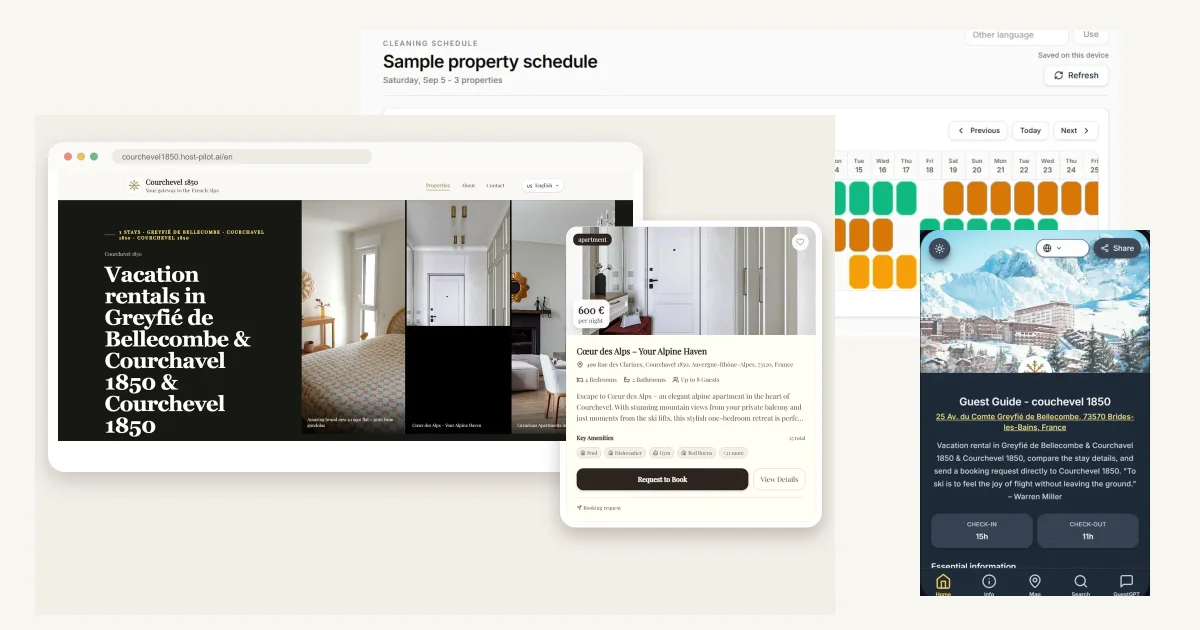
A listing URL can initialize a direct booking website and digital guest guide in Host Pilot. Connected communication can point to the same reviewed content, reducing the need to maintain several copies.
Choose deeper software when the bottleneck is inventory distribution, financial operations, owners or complex teams. The systems can coexist if availability, rates and guest content each have one clear publisher.
Realistic example, not a customer claim
A changed arrival exposes disconnected tools
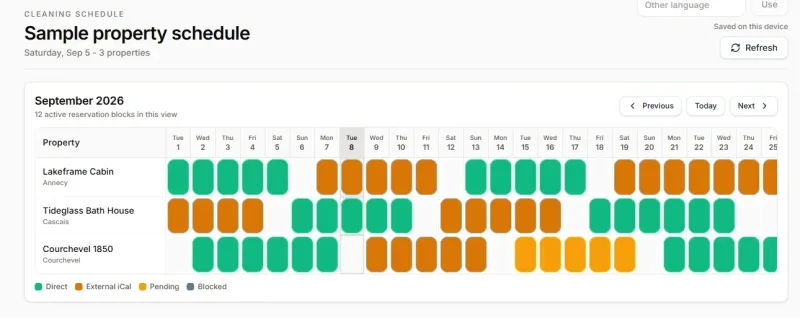
A guest moves arrival by one day. The calendar changes, but the cleaner and scheduled access message retain the old date. The host catches the conflict manually, showing that the tools exist without forming a reliable system.
The team assigns the reservation state as the trigger, requires turnover acknowledgement and retests changes and cancellations. The improvement is a clearer recovery path, not a promised percentage of time or revenue saved.
Practical workflow
Evaluate short-term rental software in six steps
- 1
Map the journey
Document booking through turnover with owners and exception points.
- 2
Assign sources
Name the systems for availability, rates, guest facts, money and tasks.
- 3
Choose the category
Separate channel, PMS, guest-experience and specialist needs.
- 4
Test reservation events
Run booking, modification and cancellation end to end.
- 5
Test failures
Simulate delivery, task, access and integration problems.
- 6
Measure maintenance
Review interventions, errors, recovery and ongoing ownership.
Short-term rental software FAQ
What does short-term rental software do?
It may support reservations, availability, rates, messages, turnovers, payments, direct bookings and reporting. Products cover different parts of that workflow.
Does one property need a PMS?
Not always. A reliable calendar, guest guide and clear communication may solve the main problems. A PMS adds value as channels, payments, owners or roles become complex.
How should I test software?
Use booking, modification, cancellation and realistic failure cases. Confirm that errors are visible and a person can pause, correct and recover the workflow.
Can automation replace the host?
No. Safety, exceptions, refunds, complaints and uncertain access need human judgment and ownership.
Does software guarantee more bookings?
No. Software can improve consistency, but demand, offer quality, pricing, reputation and execution still influence bookings.
Where does Host Pilot fit?
Host Pilot provides a listing-led direct website, digital guest guide and connected communication for hosts whose reservation core is already adequate.
Useful next steps
Design the host workflow
Start with one reviewed listing
Start with the short-term-rental journey, not a software catalogue
Short-term rental software should make reservation changes, calendar ownership, guest information, turnovers and exceptions easier to see and control. A small host may need a focused guest-experience layer; a multichannel manager may need a PMS, channel manager, payment workflow and role controls. The right stack follows the operation’s real bottleneck and must be tested with ordinary and failure cases.